Water inside after a storm: start with the conditions
Heavy rain or flooding can leave a home with several connected problems: an active entry point, wet finishes, affected belongings and uncertainty about what happens next. Friendly Hills Restoration serves Rochester Hills and Shelby Township. Call 586-474-5425 for 24/7 emergency inquiries about interior storm and flood damage cleanup.
Tell the representative whether the storm is ongoing, whether water is still entering and which areas are affected. Describe observations rather than conclusions. Water near a window, staining below a roof area or water across a basement floor are useful details. They do not, by themselves, confirm the exact source or the repair required.
The restoration plan should distinguish interior cleanup from repairs to the building exterior, drainage, plumbing or other sources. Those repairs may need an appropriate separate provider. Removing water from a room does not establish that the entry condition is corrected, and an exterior repair does not document the condition of the materials already wet inside.
For immediate danger, follow emergency instructions and contact responders when needed. Do not enter flooded roads, unstable areas or rooms with uncertain electrical safety to arrange cleanup. A clear phone description from a safe place is enough to begin discussing the next step.
Reentry and active-weather priorities
If you left the property or authorities restricted access, follow the applicable reentry instructions. Do not assume the end of rainfall means the building, utilities or access route are ready for normal use. Tell the restoration contact about any remaining restrictions so the assessment can be arranged around the actual conditions.
Standing water near electrical equipment, damage overhead and unstable building components require appropriate evaluation. Keep clear rather than attempting to operate household pumps, fans or appliances in uncertain conditions. If there is significant basement flooding or water around the structure, do not improvise a pumping timetable from a general article.
The CDC guidance for returning home after a natural disaster offers recovery precautions and recommends documenting damage and contacting your insurer. Take photographs only where it is safe. A claim record is useful, but it does not justify entering a hazardous room or climbing onto a damaged roof.
If water is still entering, explain whether a source provider has already been contacted. Temporary protection, source evaluation and interior cleanup may need coordination. Confirm which party is responsible for each task. Do not assume an interior restoration agreement includes roofing, tree removal, electrical service or every form of exterior emergency work.
Different entry paths mean different assessment questions
Water reported at a roof or upper-wall area raises questions about ceilings, insulation, adjacent rooms and the route below. The assessment should connect the visible staining to accessible observations and identify what remains concealed. If further opening is proposed, ask why it is needed and how the resulting repair will be handled.
Water near a window or door requires a separate look at the entry condition and affected interior assembly. Flooring transitions, trim and nearby wall cavities may need attention. A surface stain does not explain whether water is still entering or whether the underlying construction has been assessed. Keep source repair and interior material decisions distinct.
Basement water can involve the floor, wall perimeter, storage and household systems. The location of a puddle is a useful observation but not a complete diagnosis. Tell the representative about drains, sump areas, prior flooding and any work already performed. Our flooded basement cleanup guide covers these layout-specific questions in detail.
Outdoor floodwater requires a cleanup conversation that accounts for its path and possible contamination. Do not describe it as ordinary clean water because rainfall started the event. Share what is known and unknown about the source. If a drain or sewage backup may be involved, report that immediately so the appropriate assessment can be discussed.
Know what each stage covers
Use these distinctions when reviewing a proposal. The actual scope should follow your property’s assessed conditions.
| Stage | Primary focus | What to clarify |
|---|---|---|
| Water removal | Accessible water in the agreed areas | Work performed and remaining affected assemblies |
| Cleanup and drying | Retained materials, cleaning needs and moisture | Material decisions, monitoring and limitations |
| Repairs | Replacement materials and finishes | Readiness information and a separate repair scope |
Building an event record while facts are fresh
A simple chronology is valuable after a storm. Record when the weather occurred, when damage was discovered and what was observed. Separate those times if nobody was present during the event. Note whether water continued to enter and when any source work or temporary protection was performed.
Organize observations by room or building area. For example: ceiling stain in the upstairs hall, water at the basement stair, damp flooring near the rear door. This is more useful than a single note that the house flooded. It helps the assessment and makes later discussions about scope boundaries easier to follow.
Keep photographs of safely accessible conditions and preserve service reports, estimates and communications. If belongings are involved, maintain an item record separate from building damage. Do not move potentially affected contents through clean rooms or disturb unsafe materials merely to create a better photograph.
If earlier storm damage or repairs exist, disclose that history. A current claim or restoration scope should distinguish observed new conditions from known prior conditions where possible. The provider should not promise to make that distinction from a phone call alone, but the history should be available when the property is assessed.
Call for emergency restoration in Rochester Hills or Shelby Township.
Interior cleanup: removal, material decisions and drying
Accessible-water removal is often an early interior task once conditions allow. Ask which rooms and surfaces are included and what assessment follows. Extraction can remove visible water while leaving moisture in assemblies that require further evaluation. Our emergency water extraction guide explains that boundary.
Material decisions should consider the actual source, exposure and construction. Flooring, wall finishes, insulation, cabinet bases and contents may not receive the same treatment. Ask for the reason behind proposed removal or retention and for concealed limitations to be recorded. A one-size-fits-all promise is not a substitute for that assessment.
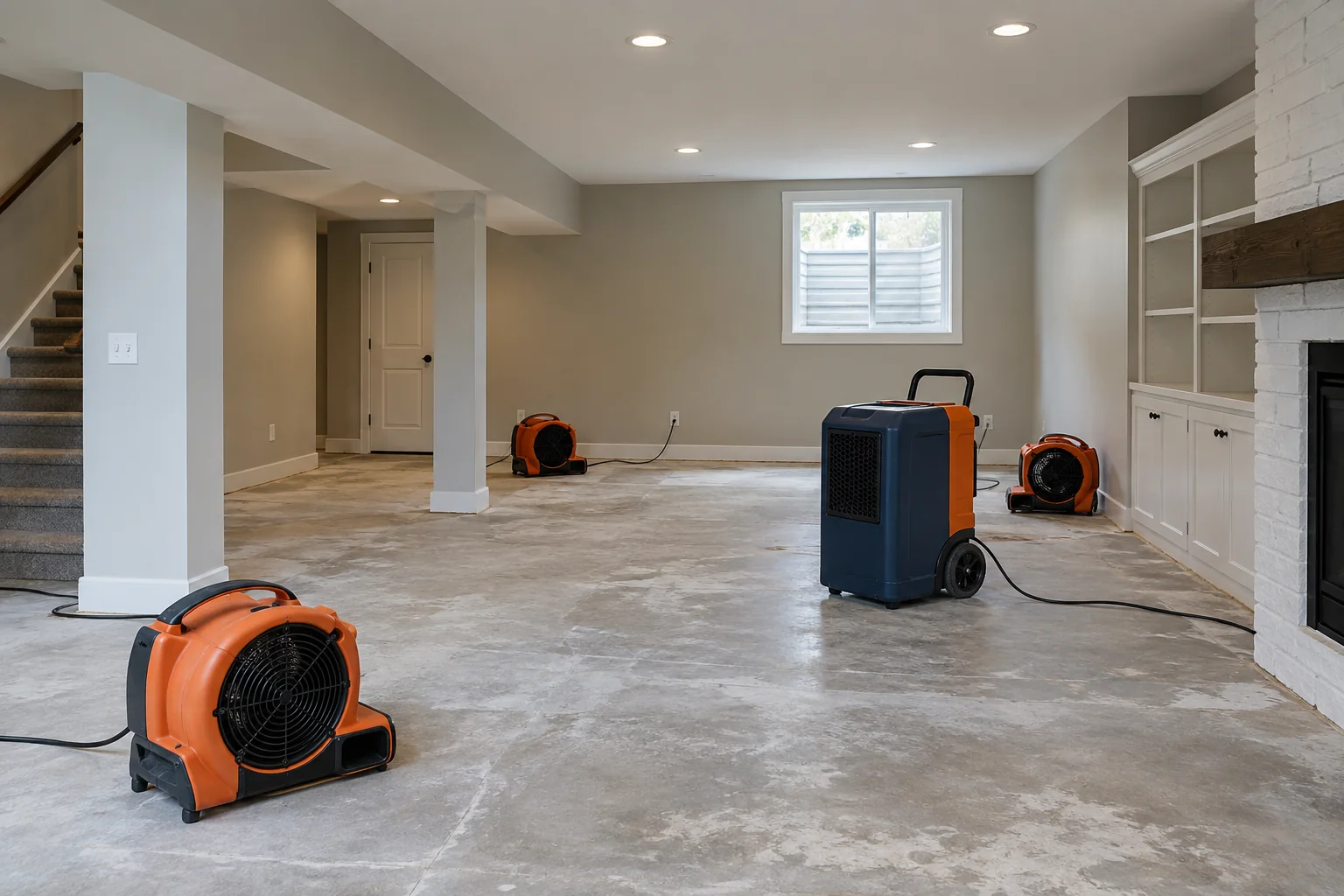
Where materials remain, drying should have a defined purpose and monitoring plan. Ask which areas are being addressed, how progress will be checked and what would trigger a revised approach. Equipment use should connect to the affected materials instead of being presented as a standard number of machines for every house.
Cleaning and contamination considerations may change the sequence. Storm-related water from outside the building is not automatically equivalent to a recent isolated supply leak. Be clear about the event history and let the responsible professionals determine the appropriate scope. Do not begin an improvised chemical treatment based on the appearance of the water.
Illustrative storm cleanup scenarios
These are illustrative examples, not completed Friendly Hills projects. They show why storm cleanup needs a property-specific sequence and clearly assigned responsibilities.
A roof-area leak stains an upstairs ceiling
Rain is followed by a ceiling stain and damp material in an upstairs room. A suitable source provider needs to evaluate the entry condition. The interior restoration assessment needs to consider the affected ceiling assembly, adjacent areas and any water path below. The homeowner should ask which work depends on source repair and what access may be required.
The painting decision belongs later in the sequence. Cosmetic improvement cannot replace understanding the entry condition or determining whether affected materials are ready. Ask for a clear handoff between source work, drying or removal and finish repairs.
Water enters a finished basement during heavy rain
The homeowner sees water near a wall and across several floor areas. The source remains uncertain, and the basement contains a recreation room and storage closet. The cleanup scope should map those spaces while the appropriate source investigation proceeds separately. Repeated entry should be reported rather than treated as a new, unrelated puddle each time.
The contents and flooring plan may require several decisions. Ask who handles stored items, what can remain in place and how work routes are managed. An estimate based only on the recreation-room square footage may not account for access and contents in the adjoining closet.
Outdoor water reaches a ground-floor room
Water crosses an exterior threshold and affects flooring and furniture. The homeowner should report the outside-water exposure rather than describe only the wet floor. The assessment needs to consider the affected assembly and contents, while the exterior entry issue requires its own explanation and repair responsibility.
In this scenario, cleanup and rebuilding should be separated clearly. The family needs to know what the emergency scope accomplishes, which materials remain under evaluation and what conditions must be met before replacement finishes are installed.
Coordinating source repairs and restoration
Storm recovery often involves more than one provider. A roofer may address an opening, a plumber may investigate a drain, an electrician may evaluate affected systems and a restoration provider may handle interior mitigation. Identify the point of contact for each responsibility and keep their findings available to the others as appropriate.
Ask which tasks can overlap and which must wait. Interior work may be limited by ongoing entry or access restrictions. Finish work may depend on cleanup and drying completion. A practical schedule should show these dependencies rather than imply that every trade can start independently on the same day.
If temporary protection is used, clarify what it accomplishes and what permanent work remains. Do not allow the temporary status to disappear from the project record once the weather improves. The household needs a clear answer about who is responsible for the final source repair and how completion will be confirmed.
Keep changes in scope explicit. If another room becomes affected during a later storm or concealed damage is found, document the new observation and revised work. That makes it easier to distinguish the original agreement from added tasks and prevents a complex event from becoming an open-ended, undocumented project.
Cost factors and insurance questions
Storm cleanup pricing depends on the affected areas, source conditions, access, materials, contents and the work required. Exterior source repairs, emergency interior mitigation and rebuilding may be separate estimates. Ask for those categories to be identified so the totals can be compared meaningfully.
Check whether extraction, removal, disposal, cleaning, drying equipment, monitoring and contents handling are included. Ask about additional assessments and specialist services. Where quantities or equipment duration are preliminary, understand how they will be reviewed and how changes will be approved before the final invoice.
Insurance questions should go to the insurer under the relevant policy. Do not assume every kind of storm-related water has the same coverage or that the word “flood” in everyday conversation determines a claim outcome. Give accurate observations, provide requested records and ask the insurer to explain its requirements and decision.
The recovery timeline can depend on source repairs, weather, material availability and other providers as well as interior labor. Ask for the current sequence and unresolved dependencies. A precise completion date should not be treated as certain before those conditions are understood. Keep household access and temporary living arrangements in the discussion as needed.
Repair readiness and follow-up after the storm
Before rebuilding, review the status of the source, the cleaned and dried areas and any remaining evaluations. Ask which records support the handoff to repair work and whether any assemblies still require access. The structural drying guide explains why replacing finishes and documenting drying completion are different milestones.
Discuss the repair scope separately from optional improvements. Replacing an affected finish, upgrading a room and repairing a pre-existing condition are different decisions. Clear estimates help you understand what is being restored and what additional work you are choosing for other reasons.
Keep the event record after completion. If a later storm produces renewed staining or dampness, the earlier observations and repair locations can help the next evaluation. Report what changed rather than assuming the new condition must have the same cause. A useful follow-up starts with facts from both events.
Storm and flood cleanup FAQs
Should I call while the rain is still falling?
You can call to describe the situation and discuss the next step. Explain that conditions are ongoing and whether water is still entering. Access, source needs and current availability must be considered before service is arranged. For immediate danger, follow emergency instructions and contact responders first.
Does interior cleanup include repairing my roof?
Not automatically. Roofing and other source work may require a separate appropriate provider and agreement. Ask who handles the entry condition and how the interior work is coordinated. A cleanup visit should not be mistaken for a completed exterior repair, even when both relate to the same storm.
Is storm water always treated like a pipe leak?
No assumption should be made that the source and exposure are equivalent. Explain whether water came from outside, through a roof area, from a drain or from an unknown location. Those facts help determine the assessment and cleanup requirements. Appearance alone does not establish the water's condition.
Can I just repaint the ceiling stain?
First establish the entry condition and the state of the affected materials. Painting can change appearance without answering those questions. Ask what source work, assessment and drying or removal decisions are needed before finish repair. A stain may be small while the concealed assembly still requires evaluation.
What if the same area flooded before?
Share the earlier event, source findings and repair records. The current damage still needs assessment, but history can clarify unresolved questions. Do not assume the previous cleanup repaired every possible source. Ask what evidence supports the present explanation and what remains uncertain before authorizing new finish work.
How can I request local storm cleanup help?
Call Friendly Hills Restoration at 586-474-5425 for Rochester Hills and Shelby Township. Emergency inquiries are accepted 24/7. Describe the affected rooms, active entry and any restrictions. The next assessment step and current service availability can be discussed without requiring a complete diagnosis from you.