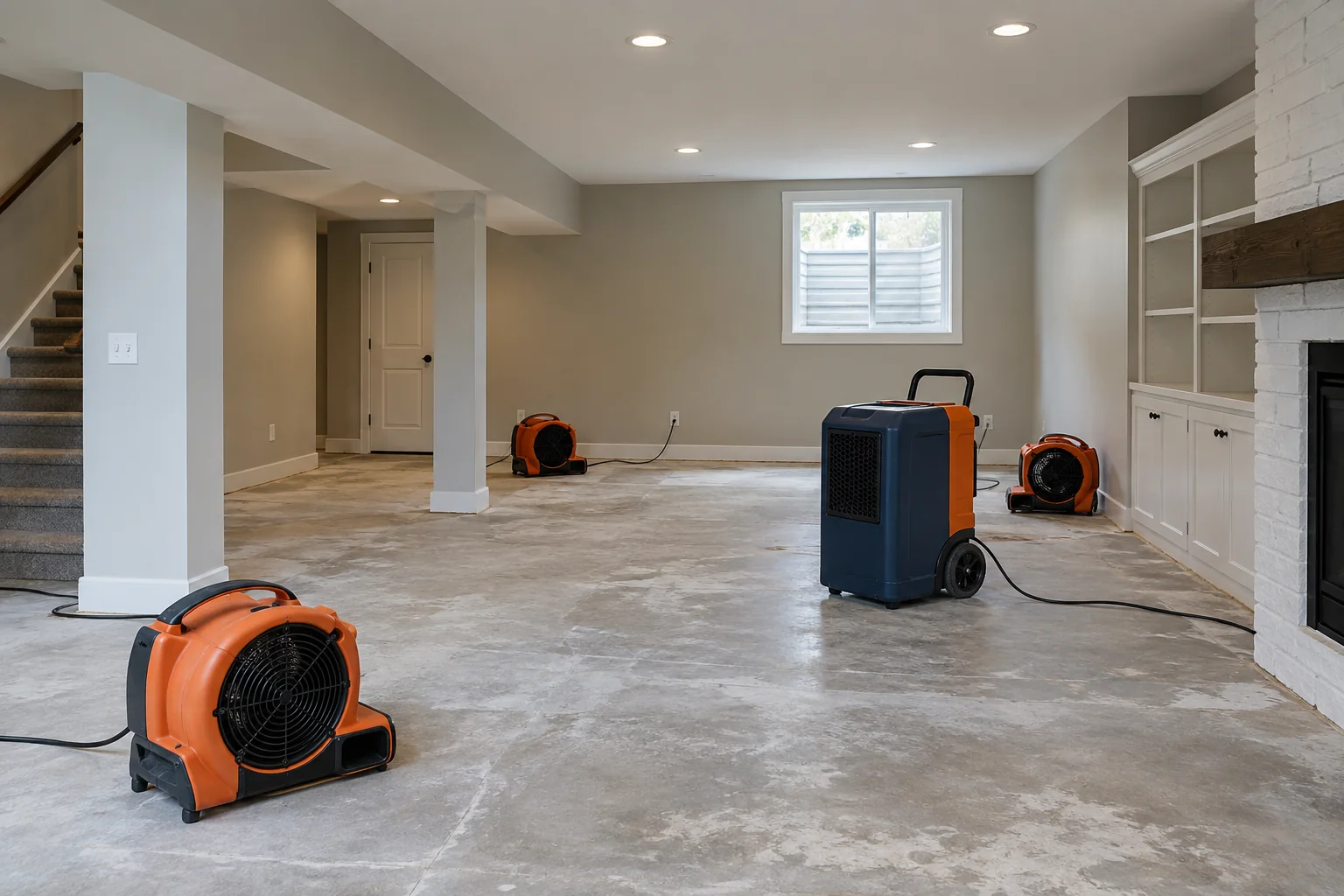
Basement flooding needs a whole-room plan
A flooded basement can affect living space, utilities, stored belongings and the route between them. The cleanup should account for the basement as a complete area, including finished rooms and less visible storage corners. Friendly Hills Restoration serves Rochester Hills and Shelby Township. Call 586-474-5425 for 24/7 emergency inquiries and describe where the water is, whether it is still entering and any known access hazards.
The first conversation does not require an exact water depth or a complete diagnosis. “Water is across the finished room and near the furnace area” gives a useful starting point. Explain whether the basement is finished, partially finished or primarily storage. Mention floor drains, sump equipment and appliances when they are relevant, but do not enter an unsafe area to inspect them.
Basement cleanup can involve accessible-water removal, affected-material assessment, contents handling, cleaning, drying and eventual repairs. It may also require a separate investigation into how the water entered. The cleanup agreement should distinguish those tasks. Removing water after a storm does not itself establish that a drainage, plumbing or foundation-related problem has been repaired.
Before going downstairs
Stay out of standing water when electrical safety is uncertain. Do not walk through water to reach a breaker, appliance or sump equipment. A basement can also have restricted exits, slippery stairs or damaged building materials. If immediate danger is present, contact emergency responders or the appropriate utility rather than attempting cleanup first.
If the building has significant flood exposure or uncertain structural conditions, obtain appropriate evaluation before pumping. This guide does not prescribe how quickly a basement should be emptied. Water conditions around the structure can matter as well as water inside it. Explain any outside flooding and official access restrictions when requesting help.
The FEMA homeowner and renter guide to urban flooding discusses flood hazards and recovery considerations. Treat electrical systems and potentially contaminated water as safety questions, not obstacles to work around with improvised household equipment.
From a safe landing or dry location, note the areas you can see and those you cannot. Tell the representative if the water may involve a sewer backup or if the source is unknown. Clear appearance does not establish that water is safe to contact. Keep children and pets away until the relevant access and cleanup plan has been established.
Understanding the source without guessing
A basement may become wet after a plumbing failure, equipment problem, drain backup or water intrusion during a storm. The area where water collects can help describe the problem, but it does not always prove the entry point. Report observations accurately: the timing, weather, visible flow, affected rooms and any service work already performed.
If a sump or drainage component appears involved, explain what was observed without assuming the cleanup provider will replace it. A plumber, drainage contractor or other appropriate professional may need to evaluate the source. Ask who will coordinate that work and how the cleanup plan changes if water continues to enter.
If the problem has happened before, share the earlier event and repair history. Was water found in the same corner? Was a drain serviced? Were finishes replaced? Old photographs or invoices can provide useful context, but the current conditions still need assessment. A previous repair should not be treated as proof that every possible source has been eliminated.
For a confirmed pipe failure, see our burst pipe water damage guide. For exterior water intrusion, the storm and flood cleanup guide covers event documentation and coordination with source repairs. Possible sewage involvement should be disclosed immediately and considered through the sewage backup cleanup guide.
Know what each stage covers
Use these distinctions when reviewing a proposal. The actual scope should follow your property’s assessed conditions.
| Stage | Primary focus | What to clarify |
|---|---|---|
| Water removal | Accessible water in the agreed areas | Work performed and remaining affected assemblies |
| Cleanup and drying | Retained materials, cleaning needs and moisture | Material decisions, monitoring and limitations |
| Repairs | Replacement materials and finishes | Readiness information and a separate repair scope |
Finished basements: the layers behind the room
A finished basement often combines flooring, trim, drywall, insulation, closets and built-in storage. The visible surface can conceal materials that need separate evaluation. Ask how the scope accounts for lower walls, transitions, enclosed corners and adjacent utility spaces. A plan based only on the open recreation area may leave important access questions unresolved.
Carpet and pad require a decision about the entire assembly. The water source, material condition and extent of exposure influence that decision. Ask what can reasonably be retained, what may need removal and how the supporting floor will be assessed. Do not assume that an extraction pass means the pad and underlying surface have been addressed.
With laminate, wood, tile or other hard finishes, ask about seams, underlayment and the supporting surface. A dry-looking top layer does not explain what is happening underneath. If removal is proposed, clarify whether it is for access, damage or another documented reason, and what repair work will follow.
Closets and built-ins deserve their own scope lines when affected. Tight spaces can change access, contents handling and drying arrangements. Ask whether shelving, cabinet bases and stored belongings must be moved, who handles them and how any disturbance will be repaired. The estimate should not rely on the basement being empty if it plainly is not.
Call for emergency restoration in Rochester Hills or Shelby Township.
Unfinished areas and household systems
An unfinished basement may look simpler because framing and the floor are exposed, but it can contain essential household systems and substantial stored property. Tell the representative about furnaces, water heaters, laundry equipment, electrical equipment and areas you cannot access. Cleaning the surrounding floor is different from evaluating whether a system is ready to operate.
Appliances and mechanical systems exposed to water may require the appropriate specialist. Ask who will assess them and keep that responsibility separate from extraction or surface cleaning. Do not test an affected appliance to decide whether a service visit is necessary. Report what happened and follow qualified guidance on operation.
Storage can make the work more complicated than the room dimensions suggest. Items may block the wall perimeter, conceal the water boundary or need evaluation before movement. Clarify how contents will be inventoried and staged. A structured approach can prevent confusion over what was wet, what was moved and what decisions remain pending.
If part of the basement stays in use, agree on access routes. The household may still need laundry access, a freezer or a passage to another area. Those needs should be discussed before equipment and work boundaries are established. Do not alter the setup on your own to restore a convenient route.
A practical cleanup sequence
The exact sequence depends on conditions, but the agreement should explain how immediate safety and source issues connect with removal, cleanup and drying. Ask what must happen before each stage can start. This is particularly important when outside water is still present or another trade must address an active entry point.
Accessible water removal helps expose the affected area for further assessment. Material and contents decisions then need to be documented. Where removal is required, ask about the boundaries, disposal and protection of adjoining spaces. Where materials are retained, ask how their condition and drying progress will be evaluated.
Drying should address the materials that remain, with a monitoring plan and a defined contact for equipment problems. Ask which rooms or cavities are being addressed and what completion evidence will be provided. The sound of equipment running does not tell you whether every affected assembly has been included.
Repairs follow the relevant cleanup and drying decisions. Baseboards, wall finishes, flooring and cabinets may be separate work. Ask for the handoff point before booking those trades. The structural drying guide explains what to discuss before covering previously wet materials with new finishes.
Illustrative basement cleanup examples
The following are illustrative scenarios, not completed Friendly Hills customer projects. They show how different basement layouts lead to different planning needs.
A recreation room floods around its perimeter
Water is visible near the wall edges and carpet, but the center of the room looks less affected. The assessment should consider the perimeter, carpet assembly, wall bases and nearby closets. The homeowner should ask which areas will be inspected and how the apparent boundary will be checked instead of assuming the dry-looking center tells the whole story.
The repair discussion should remain separate from the emergency scope. Continuous flooring and matching trim may create later finish decisions that extend beyond the initial wet area. Those decisions need a clear estimate and authorization rather than being implied by the first extraction visit.
A storage basement has water among boxes
The floor is accessible only through narrow aisles. Some containers appear dry, while others sit in water. The plan should identify how the affected contents will be assessed and moved, where staging occurs and who authorizes disposal. The homeowner can identify priority items without attempting to retrieve them through unsafe water.
This example also raises documentation questions. An item inventory and photographs taken safely can help distinguish building cleanup from belongings. The owner should ask what handling and storage charges apply before agreeing to a broad instruction to clear the basement.
The basement floods again after a prior cleanup
The same area is wet after another storm. The previous cleanup record may help, but the current event still needs a source and damage assessment. Ask whether the earlier source repair was completed and what evidence supports the current explanation. Repeating the same interior cleanup without clarifying unresolved entry conditions can leave the household without a durable recovery plan.
Cost, timing and the questions that prevent surprises
Basement size is only one part of pricing. Depth and accessibility of water, finished materials, contents, contamination concerns, equipment requirements and follow-up visits can all affect the work. Ask for a scope that identifies rooms and materials rather than a single unexplained basement-cleanup figure.
Clarify whether the estimate includes moving belongings, removing affected finishes, disposal, drying equipment and monitoring. Ask whether appliance or source evaluations are separate. If equipment is billed by time, understand the review process and how additional days are approved. If more damage is found behind a wall, know who can authorize the revised scope.
The timeline should distinguish emergency removal from drying and rebuilding. A room may be free of standing water while still restricted for other work. Discuss stairs, storage access, noise and essential household systems so the temporary arrangement is practical. A precise finish date may remain uncertain until concealed conditions and source repairs are understood.
Keep the signed agreement, changes and stage records together. If insurance is involved, ask the insurer about applicable coverage and documentation. The reason water entered can matter to the claim, but the insurer makes the coverage decision. Do not treat a cleanup proposal as a promise that all basement water losses are covered.
Preparing for the return to normal use
Before replacing stored items, ask what work is complete and what remains open. A clean floor does not automatically mean every wall assembly, appliance or repaired entry point has been evaluated. Keep pending system checks and repairs visible on the completion list rather than losing them when equipment leaves.
Review the finished scope room by room. Compare the work with the agreement, note any remaining damage and ask for the records supporting drying completion where applicable. If new flooring or wall finishes are planned, confirm the relevant readiness requirements with the installer as well as the restoration provider.
Keep information about the event available for future reference. A dated record of the source, affected areas and repairs is more useful than a general memory that the basement once flooded. If water returns, that record helps the next assessment start with actual history instead of reconstructing the sequence from scratch.
Flooded basement cleanup FAQs
Is a shallow basement flood still worth calling about?
Yes. A thin layer of water can still involve flooring edges, wall bases, storage and nearby systems. The visible depth alone does not determine the scope or safety. Call with what you can observe from a safe place and explain the source if known. You do not need to inspect every corner first.
Can I go downstairs to check the sump?
Do not enter standing water or an area with uncertain electrical safety to inspect equipment. Describe the situation and seek appropriate assistance. The need to understand the source does not justify crossing a hazardous space. A professional evaluation may be necessary before access or equipment operation is appropriate.
Does cleanup include fixing the cause of flooding?
Only if the relevant source repair is explicitly included and handled by the appropriate provider. Drain, plumbing, foundation or other repairs can be separate from interior cleanup. Ask who is responsible for the cause and what must happen before finish repairs are completed.
Will all my basement belongings need to be discarded?
Not automatically. Each decision depends on the item, its condition and the exposure involved. Ask for assessment and documentation rather than a blanket promise of salvage or disposal. Identify valuable or sentimental items early, and clarify any specialist handling or off-site storage before authorizing it.
When can I put the basement back together?
After the relevant cleanup, drying and repair decisions have been completed for the areas involved. Ask what evidence supports readiness and whether any systems or source repairs remain unresolved. Do not use the absence of a puddle as the sole reason to reinstall flooring, close walls or return belongings.
How do I request help in Rochester Hills or Shelby Township?
Call 586-474-5425. Friendly Hills Restoration accepts emergency inquiries 24/7. Give your property location, whether water is still entering and any known hazards. The call can establish the next assessment step and current service availability without requiring you to have a complete repair plan already.